Educational information only, not medical advice; consult a qualified professional.
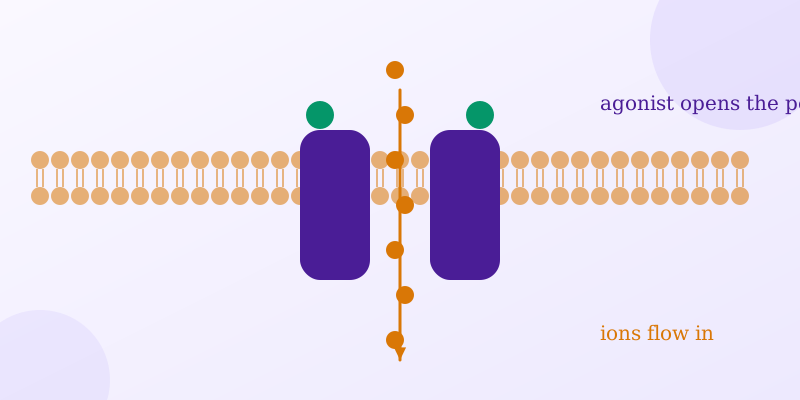
Not every receptor works through a cascade of signalling proteins. Some receptors are themselves channels: pores in the cell membrane that open when an agonist binds and let charged particles (ions) flow through. These ligand-gated ion channels are the fastest receptors in the body, responding within milliseconds. They are essential for nerve-to-muscle communication and for rapid signalling in the brain.
How they work
A ligand-gated ion channel is built from several protein subunits arranged around a central pore. The binding sites for the natural messenger sit on the outside of the channel, usually at the interfaces between subunits. When agonist molecules bind, the subunits twist slightly and the pore opens. Depending on the channel, positively charged ions such as sodium and calcium flow in, which tends to excite the cell, or negatively charged chloride ions flow in, which tends to inhibit it. When the agonist leaves or is broken down, the channel closes again. Many channels also enter a desensitised state if the agonist stays bound, closing even though the agonist is still present.
The main families
- Nicotinic acetylcholine receptors are excitatory cation channels. At the junction between nerve and skeletal muscle they convert the release of acetylcholine into muscle contraction. Other nicotinic subtypes are found in the autonomic nervous system and the brain. Nicotine is the classic exogenous agonist.
- GABA-A receptors are chloride channels activated by GABA, the main inhibitory neurotransmitter in the brain. Opening them generally makes neurons less likely to fire.
- Glycine receptors are inhibitory chloride channels that are particularly important in the spinal cord and brainstem.
- 5-HT3 receptors are the only serotonin receptors that are ion channels; all other serotonin receptors are G protein-coupled.
- Ionotropic glutamate receptors (AMPA, kainate and NMDA types) carry most fast excitatory signalling in the brain. NMDA receptors are unusual in needing both glutamate and a co-agonist (glycine or D-serine), as well as a change in membrane voltage, to open fully.
Agonists, partial agonists and antagonists at channels
The same vocabulary used for other receptors applies here. Varenicline, used to help people stop smoking, is a partial agonist at certain brain nicotinic receptors: it produces a moderate level of channel activation while reducing the effect of nicotine from cigarettes. Neuromuscular blocking drugs used during anaesthesia are nicotinic antagonists at the nerve-muscle junction (or, in one case, a depolarising agonist that leaves the channels in a desensitised state). Ondansetron and related anti-sickness medicines are antagonists at 5-HT3 receptors. Ketamine blocks the NMDA receptor channel from inside the pore, a mechanism known as channel block.
Modulators are not agonists
Many important drugs that act at ion channels do not activate them directly. Benzodiazepines, for example, bind to a different site on the GABA-A receptor and increase the effect of GABA when GABA is present; they are positive allosteric modulators, not agonists. This distinction explains why their effects depend on the brain's own GABA activity. Other substances such as barbiturates and some general anaesthetics also modulate GABA-A receptors, and at higher concentrations some of them can open the channel directly, which is one reason they carry greater risk, especially when combined with other sedating substances such as alcohol or opioids.
Why speed matters
Because ion channels translate a chemical signal straight into an electrical change, they suit tasks that need precise timing: contracting a muscle, relaying a sensory signal or shaping patterns of brain activity. G protein-coupled receptors, by contrast, take longer to act but can amplify and prolong a signal. The brain uses both types, often for the same messenger; GABA, glutamate, acetylcholine and serotonin each have both ion-channel and G protein-coupled receptors.
Key points
- Ligand-gated ion channels open a pore within milliseconds of an agonist binding.
- Cation channels (nicotinic, glutamate, 5-HT3) excite cells; chloride channels (GABA-A, glycine) inhibit them.
- Partial agonists and antagonists at channels have practical uses, from smoking cessation to anaesthesia and anti-sickness treatment.
- Allosteric modulators such as benzodiazepines enhance the natural agonist rather than acting as agonists themselves.
General pharmacology education only, not medical advice. Do not combine sedating medicines or substances without guidance from a clinician.