Educational information only, not medical advice; consult a qualified professional.
For most of the twentieth century, an agonist was thought of as simply turning a receptor "on". Research over the past few decades has shown that the picture is more nuanced. Some agonists acting on the same receptor appear to favour certain downstream signals over others. This property is called biased agonism, or functional selectivity, and it is one of the more interesting ideas in modern pharmacology.
One receptor, several pathways
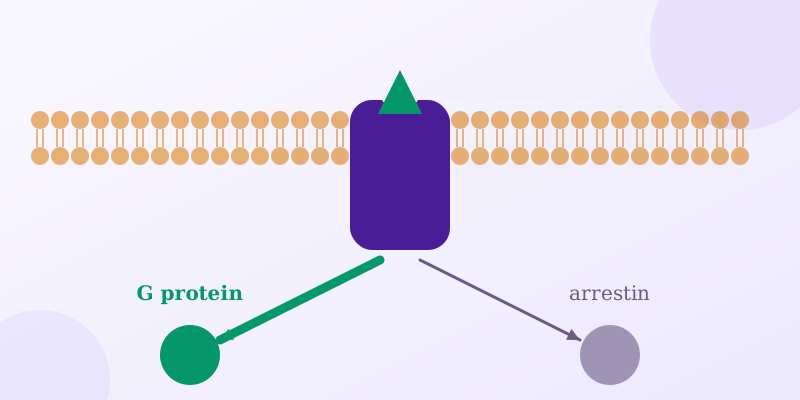
A G protein-coupled receptor that has been activated can interact with more than one partner inside the cell. The classic partner is a G protein, which changes levels of messengers such as cyclic AMP or calcium. Another set of partners are the arrestins. Arrestins were first known for switching off G protein signalling and pulling receptors into the cell, but they can also act as scaffolds that start other signals. Some receptors can also engage more than one type of G protein.
A "balanced" agonist activates these pathways in roughly the same proportions as a reference agonist, usually the body's own messenger. A biased agonist activates one pathway relatively more than another.
How bias is thought to arise
Receptors are not rigid on-off switches. They flexibly move between many shapes. Different agonists are thought to stabilise slightly different active shapes, and each shape may be better at engaging a particular partner. Structural studies of receptors bound to different ligands support this idea, although the details vary from receptor to receptor.
Bias can also be measured artefactually. The result depends on which pathways are measured, which cell type is used, how many receptors and partner proteins are present, and which reference agonist is chosen. Pharmacologists use specific analytical methods to separate genuine ligand bias from these "system" effects, and results do not always transfer from cells in a dish to the body.
Why researchers became interested
The appeal of biased agonism is the possibility of keeping a drug's useful effect while reducing unwanted ones, if those effects travel through different pathways. Opioid receptors are the best-known example. Early studies in genetically modified mice suggested that some opioid side effects might depend on arrestin signalling, while pain relief depended mainly on G protein signalling. That led to the development of opioid agonists described as G protein-biased, and one such medicine, oliceridine, has been approved in the United States for hospital use in acute pain.
Later research has complicated the story. Some of the original findings have been difficult to reproduce, and it has been argued that the apparent benefits of some "biased" opioids may reflect lower efficacy (partial agonism) rather than true pathway bias. Clinical evidence that biased opioids are meaningfully safer than conventional ones remains limited, and they are still opioids with the risks that implies. The debate is a good illustration of how a promising laboratory concept is tested and refined.
Other receptors under study
Biased ligands have been explored for many receptors, including angiotensin, adrenergic, dopamine, serotonin, cannabinoid and GLP-1 receptors. Some medicines that were developed before the concept existed have since been found to show bias in laboratory tests. Whether designing for bias reliably improves the balance of benefit and harm in patients is still an open research question.
What this means for readers
Biased agonism is mainly a research and drug-design concept. It helps explain why two drugs that act on the same receptor can differ in their effects, and it may shape future medicines. It is not a reason to prefer one existing medicine over another without professional advice, and marketing language about "biased" or "next-generation" mechanisms should be read with care.
Key points
- An activated receptor can signal through G proteins, arrestins and other partners.
- A biased agonist favours some of these pathways relative to a reference agonist.
- Bias depends on the receptor shape a ligand stabilises, but measurement is easily confounded by the test system.
- The clinical advantage of biased drugs, especially opioids, is still being evaluated.
For general education only. Treatment decisions belong with a qualified clinician.