Educational information only, not medical advice; consult a qualified professional.
Serotonin (5-hydroxytryptamine, or 5-HT) is a messenger involved in mood, sleep, appetite, gut movement, blood-vessel tone and much more. It acts on a large family of receptors, and medicines that activate particular serotonin receptors are used in several conditions. This article gives an overview of the receptor family and the main agonist classes.
A large and varied receptor family
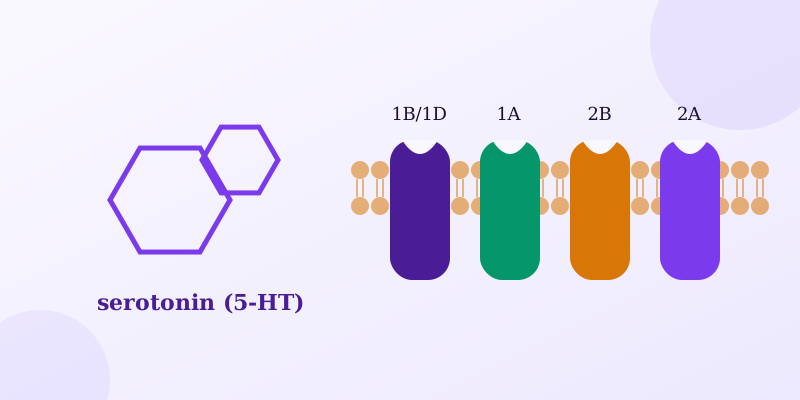
Serotonin receptors are grouped into seven families, 5-HT1 to 5-HT7, with several subtypes in some families (for example 5-HT1A, 1B, 1D, 1E and 1F, and 5-HT2A, 2B and 2C). All of them are G protein-coupled receptors except 5-HT3, which is a ligand-gated ion channel. The families couple to different signalling pathways: 5-HT1 receptors mainly reduce cyclic AMP, 5-HT2 receptors activate the phospholipase C pathway, and 5-HT4, 5-HT6 and 5-HT7 receptors increase cyclic AMP. This diversity is why serotonin's effects vary so much between organs.
Triptans: 5-HT1B/1D agonists for migraine
The triptans, starting with sumatriptan, were designed as agonists at 5-HT1B and 5-HT1D receptors. They are used to treat migraine attacks rather than to prevent them. Their effect is thought to come from several actions: narrowing of dilated blood vessels around the brain (mainly 5-HT1B) and reduced release of inflammatory neuropeptides, such as calcitonin gene-related peptide (CGRP), from nerve endings of the trigeminal system (mainly 5-HT1D). Because 5-HT1B receptors are also present in some other blood vessels, including coronary arteries, triptans are not suitable for everyone, for example people with certain heart or circulation conditions. That is one reason they are prescribed after a clinical assessment.
Ditans: a 5-HT1F approach
A newer class, the ditans (lasmiditan), acts as an agonist at 5-HT1F receptors. These receptors appear to influence trigeminal pain signalling without the same vessel-narrowing action. Lasmiditan can cause dizziness and sleepiness, and product information advises against driving for a period after taking it. This class shows how targeting a different receptor subtype can change a drug's profile while aiming at the same condition.
5-HT1A partial agonists
Buspirone, used for generalised anxiety disorder, is a partial agonist at 5-HT1A receptors. Unlike benzodiazepines, it does not act on GABA-A receptors, and its effects typically build up over a period of weeks rather than appearing after a single dose. Activity at 5-HT1A receptors is also part of the profile of several other medicines used in psychiatry.
A safety lesson: the 5-HT2B receptor
Not all serotonin agonism is desirable. 5-HT2B receptors are present on heart valve cells, and long-term activation of these receptors has been linked to thickening and malfunction of heart valves. Several medicines with 5-HT2B agonist activity were withdrawn or restricted for this reason, including the appetite suppressant fenfluramine (as part of combination weight-loss regimens) and some ergot-derived drugs. Screening new compounds for 5-HT2B activity is now a routine part of drug safety testing.
5-HT2A receptors and research
The 5-HT2A receptor is the main target through which classic psychedelic substances such as psilocybin (via its active form, psilocin) produce their effects on perception. These substances are the subject of ongoing clinical research, but they remain controlled in many countries and their use outside regulated studies carries real risks. Research findings in this area are still developing, and early results should not be read as established treatments.
Serotonin syndrome
Combining several medicines that increase serotonin activity, such as certain antidepressants, some pain medicines and some migraine treatments, can occasionally lead to serotonin syndrome, a potentially serious reaction involving agitation, fever, sweating, tremor and muscle twitching. It is a key reason to tell prescribers and pharmacists about every medicine and supplement you use.
Key points
- There are seven serotonin receptor families; all are G protein-coupled except 5-HT3.
- Triptans act on 5-HT1B/1D receptors and ditans on 5-HT1F receptors to treat migraine attacks.
- Buspirone is a 5-HT1A partial agonist with a gradual onset.
- 5-HT2B agonism has been linked to heart valve disease and is screened for in drug development.
Educational information only. Talk to a doctor or pharmacist before starting, stopping or combining medicines.