Educational information only, not medical advice; consult a qualified professional.
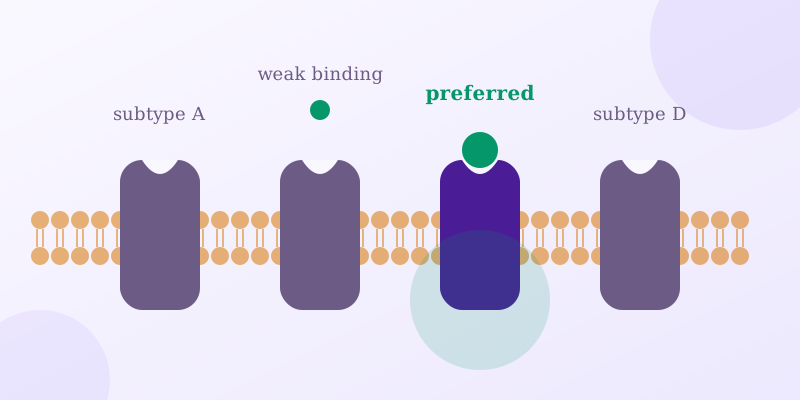
Few medicines act on only one molecule in the body. Most bind more strongly to some targets than to others, and the pattern of those preferences, called selectivity, goes a long way to explaining both why a drug works and why it causes side effects. This article explains the idea and its limits.
Receptor families and subtypes
Natural messengers usually act on several related receptors. Adrenaline and noradrenaline act on alpha-1, alpha-2, beta-1, beta-2 and beta-3 adrenergic receptors. Acetylcholine acts on five muscarinic subtypes and several nicotinic receptor types. Serotonin has more than a dozen receptor subtypes. These subtypes are distributed differently across organs and often signal through different internal pathways, so activating one subtype can produce a very different result from activating another.
A drug is described as selective when it has a clearly higher affinity or effect at one subtype than at the others. Selectivity is what allows an inhaled asthma reliever to relax airway muscle (mainly beta-2 receptors) while having less effect on the heart (mainly beta-1 receptors), or a "cardioselective" beta-blocker to act more on the heart than on the airways.
Selectivity is relative, not absolute
The most important caveat is that selectivity is a matter of degree. It is usually expressed as a ratio, for example how many times more tightly a drug binds one receptor than another. At low concentrations a drug may occupy mainly its preferred target, but as the concentration rises it begins to occupy others too. That is why selective beta-2 agonists can still speed up the heart, and why cardioselective beta-blockers are still used with caution in some people with asthma. It is also one of the reasons a dose is chosen by a clinician rather than simply increased until an effect appears.
On-target and off-target side effects
Side effects fall into two broad groups.
- On-target effects happen at the intended receptor but in an unintended tissue. Beta-2 receptors are found in skeletal muscle as well as the airways, so a beta-2 agonist can cause fine tremor even though it is acting exactly where it was designed to act.
- Off-target effects come from binding to a different receptor altogether. Older (first-generation) antihistamines, for example, also block muscarinic receptors, which can cause dry mouth and blurred vision, and they cross into the brain readily, which contributes to drowsiness.
Drug development often aims to remove off-target activity while accepting that some on-target effects are unavoidable.
Other routes to selectivity
Molecular selectivity is only part of the picture. Several other factors make a drug act where it is wanted:
- Route of delivery. Inhaled, topical and eye-drop medicines deliver a high concentration to one site while keeping levels in the rest of the body low.
- Access to tissues. Molecules that do not cross the blood-brain barrier easily have fewer effects on the brain; second-generation antihistamines were designed partly with this in mind.
- Tissue receptor reserve. A partial agonist can produce a strong response in a tissue with many spare receptors and a weak response in a tissue with few.
- Signalling bias. Some ligands favour one of several signalling pathways from the same receptor, a property called biased agonism that is covered elsewhere on this site.
Why selectivity sometimes is not the goal
Highly selective drugs are not automatically better. Some useful medicines deliberately act on several targets, and in complex conditions a broader profile can be an advantage. What matters is that the overall pattern of activity is understood, which is why medicine labels list known receptor actions and the effects that follow from them.
Key points
- Most messengers act on several receptor subtypes with different distributions and signals.
- Selectivity is a ratio and decreases as drug concentration rises.
- On-target side effects come from the right receptor in the wrong tissue; off-target effects come from other receptors.
- Delivery route, tissue access and signalling bias add further layers of selectivity.
General educational content, not medical advice. Ask a doctor or pharmacist about the medicines you use.