Educational information only, not medical advice; consult a qualified professional.
If you pick a medicine at random, there is a good chance it acts on a G protein-coupled receptor (GPCR). This large family of membrane proteins detects hormones, neurotransmitters, light, odours and tastes, and it is the target of a large share of approved drugs. Understanding how GPCRs work makes much of agonist pharmacology fall into place.
The basic structure
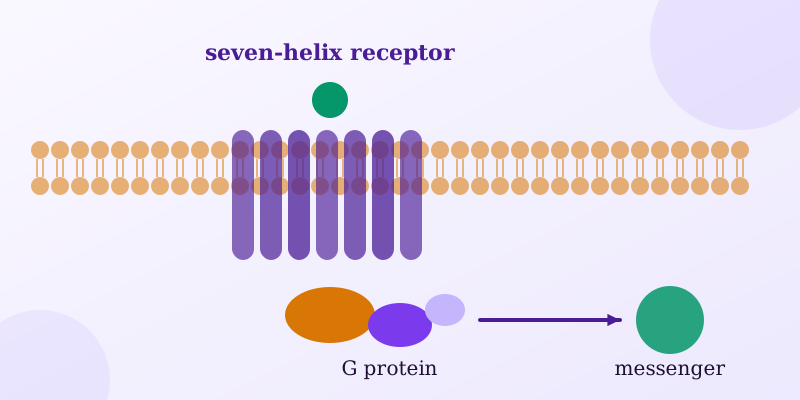
Every GPCR is a single protein chain that weaves back and forth through the cell membrane seven times, forming seven transmembrane helices. The outer part of the receptor and the pockets between the helices form the binding site for its messengers. The inner part, facing the cytoplasm, interacts with signalling proteins. Because of this shape, GPCRs are also called seven-transmembrane (7TM) receptors.
The family is commonly divided into classes. Class A (rhodopsin-like) is the largest and includes adrenergic, dopamine, serotonin, histamine, muscarinic and opioid receptors. Class B includes receptors for peptide hormones such as glucagon, GLP-1 and parathyroid hormone. Class C includes metabotropic glutamate, GABA-B and calcium-sensing receptors, which have a large external domain that grips the messenger.
How activation works
When an agonist binds, the receptor shifts into an active shape. On the inside of the membrane this exposes a surface that engages a heterotrimeric G protein, made of alpha, beta and gamma subunits. The receptor prompts the alpha subunit to swap the molecule GDP for GTP, which switches the G protein on. The subunits then act on enzymes and ion channels until the alpha subunit converts GTP back to GDP and switches itself off.
Different receptors prefer different G proteins, and that largely determines what the cell does:
- Gs stimulates the enzyme adenylyl cyclase, raising the messenger cyclic AMP (cAMP). Beta-adrenergic and GLP-1 receptors use this route.
- Gi/o inhibits adenylyl cyclase, lowering cAMP, and can open potassium channels. Opioid, alpha-2 adrenergic and D2-like dopamine receptors use this route.
- Gq activates phospholipase C, which produces IP3 and DAG; IP3 releases calcium from internal stores. Alpha-1 adrenergic and M1/M3 muscarinic receptors use this route.
A single activated receptor can switch on many G proteins, and each downstream enzyme can make many messenger molecules, so the original signal is strongly amplified.
Switching off: kinases and arrestins
Signals must also stop. After activation, GPCRs are tagged with phosphate groups by enzymes called G protein-coupled receptor kinases (GRKs). Proteins called arrestins then bind the tagged receptor, blocking further G protein coupling and often pulling the receptor into the cell. This is one of the main mechanisms behind desensitisation and tolerance when an agonist is present for a long time. Arrestins can also start signals of their own, which is the basis of the idea of biased agonism.
Why GPCRs are such good drug targets
- They sit on the cell surface, so drugs do not need to enter cells to reach them.
- They control a huge range of body functions, from heart rate to hormone release.
- Subtypes in different tissues allow some selectivity.
- Both activating them (agonists) and blocking them (antagonists) can be therapeutically useful.
Familiar examples include beta-2 agonist inhalers, beta-blockers, opioid analgesics, many antihistamines, many antipsychotics, triptans for migraine and GLP-1 receptor agonists.
A field shaped by structural biology
For decades GPCRs were studied mostly through their effects. Cloning of receptor genes from the 1980s onward, and later the first high-resolution structures of drug-binding GPCRs, transformed the field. The 2012 Nobel Prize in Chemistry was awarded to Robert Lefkowitz and Brian Kobilka for their studies of GPCRs. Structural information now supports the design of more selective agonists and antagonists.
Key points
- GPCRs have seven membrane-spanning helices and signal through G proteins.
- Gs raises cAMP, Gi lowers it, and Gq raises intracellular calcium via phospholipase C.
- GRKs and arrestins switch receptors off and contribute to tolerance.
- Many everyday medicines act as agonists or antagonists at GPCRs.
Educational information only; it does not replace professional medical advice.