Educational information only, not medical advice; consult a qualified professional.
Today it seems obvious that drugs act by binding to receptors. For a long time, though, the receptor was a hypothesis: a convenient way to explain experimental results about a structure no one had seen. This article traces how the idea grew from a speculative proposal into one of the best-supported concepts in biology.
Langley's "receptive substance"
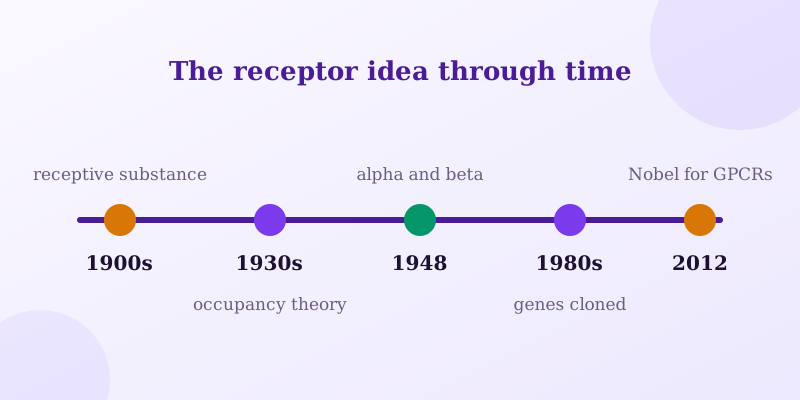
Around the start of the twentieth century, the British physiologist John Newport Langley studied how nicotine and curare affect skeletal muscle. He found that nicotine could still cause contraction after the nerve supply had been cut, and that curare could block this effect. He reasoned that the muscle itself must contain a "receptive substance" that both drugs interacted with, in competition with each other. That proposal, published in the early 1900s, contains the seeds of agonism and competitive antagonism.
Ehrlich and specific binding
At about the same time, the German scientist Paul Ehrlich was developing ideas about how antibodies, toxins and dyes bind specifically to cells. He coined the term "receptor" in this context and summed up his view in the Latin phrase corpora non agunt nisi fixata: substances do not act unless they are bound. His search for chemicals that would bind to microbes but not to human cells, the "magic bullet" idea, became a guiding principle of chemotherapy.
Measuring drug action: occupancy theory
Receptors became quantitative in the 1920s and 1930s, notably through the work of the British pharmacologist Alfred Joseph Clark. He applied the law of mass action to drug-receptor binding and showed that concentration-response relationships could be described by equations similar to those used for chemical reactions. In the simplest form of this occupancy theory, the size of the response is proportional to the fraction of receptors occupied.
Efficacy and intrinsic activity
Simple occupancy theory could not explain why some drugs produce a smaller maximal response than others even when receptors are fully occupied. In the 1950s, E. J. Ariëns introduced the term intrinsic activity, and R. P. Stephenson introduced efficacy, to describe a drug's ability to produce a response once bound, separate from its affinity. These ideas gave a framework for partial agonists, and later work on spare receptors and operational models refined it further.
Receptor subtypes
In 1948, Raymond Ahlquist compared the effects of several related compounds on different tissues and proposed two types of adrenaline receptor, which he called alpha and beta. The idea was not widely accepted at first, but it proved enormously useful. Building on it, James Black and colleagues developed beta-receptor antagonists such as propranolol, and later the H2 receptor antagonist cimetidine for stomach acid. Black shared the 1988 Nobel Prize in Physiology or Medicine for principles of drug treatment that came from this receptor-based approach.
From hypothesis to molecule
Through the 1970s, radioactively labelled drugs made it possible to measure binding directly in tissue samples, which turned receptors from inferred entities into countable sites. Researchers then purified receptor proteins and, in the 1980s, cloned their genes. The cloning of the beta-2 adrenergic receptor revealed the seven-transmembrane structure shared by a large receptor family, the G protein-coupled receptors. Other families, including ligand-gated ion channels and nuclear receptors, were characterised in parallel.
The structural era
High-resolution structures of G protein-coupled receptors bound to drugs began to appear in the 2000s, and the 2012 Nobel Prize in Chemistry recognised Robert Lefkowitz and Brian Kobilka for studies of these receptors. Advances in cryo-electron microscopy have since made it possible to see receptors in complex with their signalling partners. These pictures support ideas such as allosteric modulation and biased agonism, and they increasingly guide the design of new medicines.
Why the history matters
The story of the receptor shows how careful experiments, quantitative reasoning and new technology turned a hypothesis into a concrete molecule. Many terms used throughout this site, such as affinity, efficacy, partial agonist and receptor subtype, come directly from these steps.
Key points
- Langley and Ehrlich proposed specific receptive structures in the early 1900s.
- Clark's occupancy theory made drug action quantitative; Ariëns and Stephenson separated affinity from efficacy.
- Ahlquist's alpha/beta proposal opened the way to subtype-selective drugs such as beta-blockers.
- Binding studies, cloning and structural biology turned receptors into molecules that can be seen and designed for.
Educational history of science; not medical advice.