Dopamine Receptor Agonists: Mechanism and Clinical Context
Educational information only, not medical advice; consult a qualified professional.
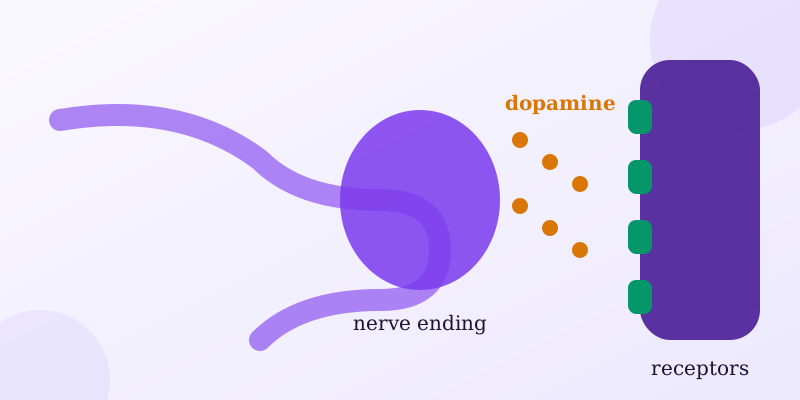
Dopamine is a neurotransmitter involved in movement, motivation, hormone control and nausea. Dopamine receptor agonists are medicines that activate dopamine receptors directly. They are used in a handful of specific conditions, and their known side effects follow logically from where dopamine receptors are found. This article explains the mechanism in general terms.
Two families of dopamine receptors
There are five dopamine receptor subtypes, all G protein-coupled receptors, grouped into two families:
- D1-like (D1 and D5): mainly coupled to Gs proteins, which increase the cellular messenger cyclic AMP.
- D2-like (D2, D3 and D4): mainly coupled to Gi/o proteins, which reduce cyclic AMP and can open certain potassium channels.
Most dopamine agonist medicines act predominantly on the D2-like family, with different drugs showing different preferences between D2 and D3.
Parkinson's disease
In Parkinson's disease, dopamine-producing nerve cells in a brain region called the substantia nigra are progressively lost. These cells normally supply dopamine to the striatum, an area that helps control movement, so their loss contributes to slowness of movement, stiffness and tremor.
The most widely used treatment, levodopa, is not itself an agonist. It is a precursor that the brain converts into dopamine. Dopamine agonists take a different route: they bypass the damaged dopamine-producing cells and stimulate the receptors directly. Examples include pramipexole and ropinirole (tablets), rotigotine (a skin patch) and apomorphine (given by injection or infusion, or as a film under the tongue in some countries). Older agonists derived from ergot alkaloids are now used much less often for Parkinson's disease, partly because of concerns about fibrosis, including of heart valves.
Restless legs syndrome
Some of the same agonists are also licensed for restless legs syndrome, a condition involving an uncomfortable urge to move the legs, typically in the evening and at night. The mechanism is not fully understood, but dopamine signalling is thought to be involved. A recognised problem with long-term dopaminergic treatment in this condition is augmentation, in which symptoms become stronger or start earlier in the day, and prescribers monitor for it.
Hormone control: prolactin
Dopamine released from the hypothalamus normally holds down secretion of the hormone prolactin by acting on D2 receptors in the pituitary gland. D2 agonists such as cabergoline and bromocriptine imitate this signal and are used to lower raised prolactin levels, for example due to certain benign pituitary tumours. This is a clear example of how the same receptor drives very different clinical uses depending on the tissue.
Known cautions
Because dopamine receptors are widespread, side effects are relatively predictable:
- Nausea and low blood pressure on standing, linked partly to dopamine receptors in the brain's vomiting centre and in blood-vessel control.
- Sleepiness, including episodes of falling asleep suddenly during daily activities, which is listed in product information and is relevant to driving.
- Impulse control problems such as compulsive gambling, shopping or eating, reported with dopamine agonists and listed as a warning; family members are often asked to watch for behaviour changes.
- Hallucinations or confusion, particularly in older people.
Stopping these medicines abruptly can also cause problems, so changes are planned with the prescriber.
Antagonists on the other side
The mirror image of this class, dopamine receptor antagonists, includes many antipsychotic medicines and some anti-sickness drugs. Their side effects, such as movement problems and raised prolactin, are essentially the reverse of the agonists' intended effects, which shows how tightly the pharmacology hangs together.
Key points
- Dopamine receptors form D1-like and D2-like families; most agonist medicines favour D2-like receptors.
- In Parkinson's disease, agonists stimulate receptors directly, unlike levodopa, which is converted into dopamine.
- Pituitary D2 receptors explain the use of agonists to lower prolactin.
- Sleepiness, nausea and impulse control problems are recognised effects that clinicians monitor.
Educational information only, not medical advice. Anyone taking or considering these medicines should discuss them with their doctor.