Dose-Response Curves Explained: Potency, Efficacy and EC50
Educational information only, not medical advice; consult a qualified professional.
The dose-response curve is the basic chart of pharmacology. It shows how the size of a drug's effect changes as its concentration rises, and it lets pharmacologists compare agonists in a consistent way. Once you can read one, terms such as potency, efficacy and EC50 become straightforward. This article is about the concept as used in research and teaching; it is not guidance about how much of any medicine to take.
The shape of the curve
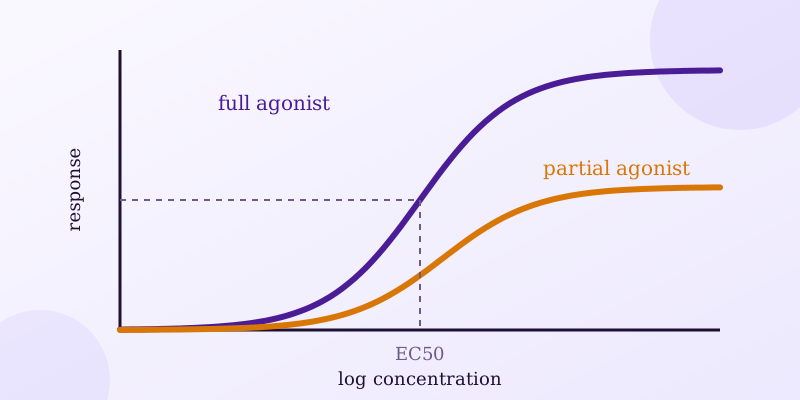
In a typical laboratory experiment, increasing concentrations of an agonist are applied to a tissue or to cells carrying a receptor, and the response is measured: muscle contraction, a change in a cellular messenger, or another readout. Plotted on an ordinary scale, the response rises steeply at first and then levels off as receptors or downstream pathways become saturated. Plotted against the logarithm of concentration, the same data form a characteristic S-shaped (sigmoid) curve, which is easier to compare across drugs that work at very different concentrations.
Emax: the ceiling of the response
The plateau at the top of the curve is the maximal effect, or Emax. It reflects the drug's efficacy: its ability to activate the receptor and produce a response once bound. A full agonist reaches the highest response the system can produce. A partial agonist levels off lower, however high its concentration goes, because even full receptor occupancy produces only part of the maximal signal.
EC50: a measure of potency
The EC50 is the concentration that produces half of that drug's own maximal effect. A lower EC50 means less drug is needed to get a given fraction of the response, so the drug is more potent. When dose rather than concentration is plotted, the equivalent term is ED50. In binding studies, the related constant for how strongly a drug attaches to its receptor is the dissociation constant (often written Kd or Ki), which measures affinity rather than response.
Potency and efficacy are not the same thing
This is the most common point of confusion. Potency is about how much drug is needed; efficacy is about how big an effect can be achieved. A highly potent drug is not necessarily better: if two medicines can produce the same maximal effect, the one needing a smaller amount is simply more potent, and that difference is usually handled by the size of the tablet or dose. A drug with greater efficacy, by contrast, can achieve a response the other cannot reach at all.
On a graph, potency moves the curve left or right; efficacy moves the plateau up or down. A competitive antagonist shifts an agonist's curve to the right without lowering the plateau, while an irreversible antagonist can lower the plateau. Reading these shifts is how pharmacologists classify new compounds.
Spare receptors and tissue differences
The same agonist can appear more potent in one tissue than another. One reason is receptor reserve (spare receptors): in some tissues a full response is reached when only a fraction of receptors are occupied, so the curve sits further to the left. Receptor numbers, signalling efficiency and the presence of enzymes that break the drug down all vary between tissues. This is why potency values are always quoted with the experimental system they were measured in.
Quantal curves and the therapeutic index
A second type of curve, the quantal dose-response curve, records whether a defined all-or-none effect occurs in each individual of a group, rather than the size of the effect in one tissue. From such curves, researchers estimate the dose producing the desired effect in half of subjects (ED50) and the dose producing a defined toxic effect in half (TD50). The ratio between them is the therapeutic index. A narrow therapeutic index means that the effective and harmful ranges are close together; medicines with this property are often monitored with blood tests and carefully individualised by prescribers.
Key points
- Plotted against log concentration, agonist responses usually form an S-shaped curve.
- Emax reflects efficacy; EC50 reflects potency.
- Higher potency does not mean a better or stronger medicine; efficacy sets the ceiling.
- Quantal curves underpin the therapeutic index, a measure of the margin between benefit and harm.
For learning purposes only. Dosing of any medicine is a decision for a licensed clinician; ask your doctor or pharmacist about your own treatment.