GLP-1 Receptor Agonists: How This Drug Class Works
Educational information only, not medical advice; consult a qualified professional.
GLP-1 receptor agonists are one of the most talked-about groups of medicines of recent years. They are used in type 2 diabetes and, for some products, in medically supervised weight management. This article explains the pharmacology behind the class: the natural hormone they imitate, the receptor they act on and why the drug versions behave differently from the body's own messenger. It does not cover choosing, dosing or obtaining these prescription medicines.
The natural hormone: GLP-1
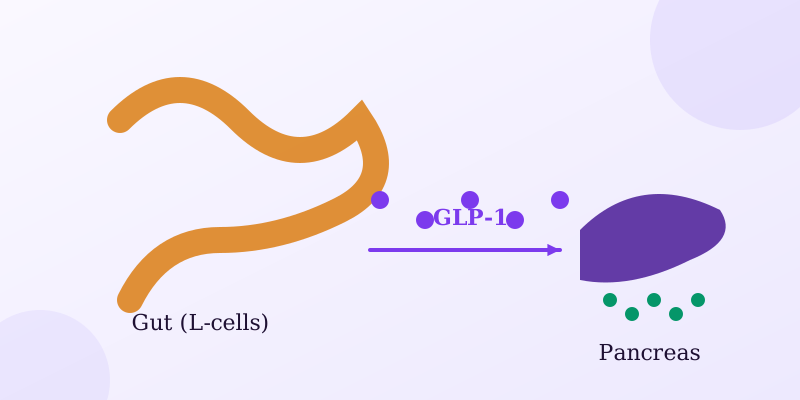
Glucagon-like peptide-1 (GLP-1) is an incretin hormone, a messenger released from the gut in response to food. It is produced mainly by specialised L-cells in the lining of the intestine. When nutrients arrive, GLP-1 is released into the bloodstream and acts on GLP-1 receptors in several organs. Together with a second incretin, GIP, it helps explain the observation that glucose taken by mouth triggers more insulin release than the same amount of glucose given into a vein.
The GLP-1 receptor
The GLP-1 receptor is a G protein-coupled receptor belonging to the class B family, which responds to peptide hormones. When an agonist binds, the receptor mainly signals through the Gs protein, raising levels of the messenger cyclic AMP inside the cell. In pancreatic beta cells this makes insulin release more responsive to glucose. An important feature is that the effect is glucose-dependent: the extra insulin release is greatest when blood glucose is raised and much smaller when it is normal or low.
GLP-1 receptors are also found elsewhere, which explains the wider effects of the class:
- Pancreas: more glucose-dependent insulin release and less glucagon release.
- Stomach: slower gastric emptying, so nutrients enter the intestine more gradually.
- Brain: signalling in areas involved in appetite and satiety, which is linked to reduced food intake.
- Heart and blood vessels, kidneys: receptors are present, and these organs are an active area of research.
Why the natural hormone is not used as a drug
Native GLP-1 lasts only a few minutes in the circulation. It is rapidly broken down by an enzyme called dipeptidyl peptidase-4 (DPP-4) and cleared by the kidneys. A medicine based on the unaltered hormone would therefore need almost continuous delivery.
Drug developers solved this in several ways. Exenatide is based on exendin-4, a peptide first identified in the venom of the Gila monster lizard that activates the GLP-1 receptor but resists DPP-4. Other agents, such as liraglutide and semaglutide, are modified versions of human GLP-1 with changes to the amino-acid chain and an attached fatty-acid chain that lets the molecule bind to albumin in the blood. This slows its removal and stretches its action from minutes to a day or about a week, depending on the product. Some products are fused to larger proteins for the same reason. Most are given by injection under the skin, and at least one is available as a tablet formulated to survive the stomach.
A separate class of tablets, the DPP-4 inhibitors (gliptins), takes the opposite approach: instead of supplying an agonist, they slow the breakdown of the body's own incretins. Newer medicines also combine actions, for example tirzepatide, which activates both GIP and GLP-1 receptors.
Effects people commonly hear about
Because the receptor is present in the gut and brain, gastrointestinal effects such as nausea, vomiting, diarrhoea or constipation are the most commonly reported side effects, particularly when treatment starts or changes. Product information for the class also lists less common but serious risks that prescribers watch for, and some products are not suitable for people with certain personal or family medical histories. These are reasons the medicines are prescription-only and supervised by a clinician.
From a pharmacology standpoint, GLP-1 agonists are a good illustration of how a short-lived natural agonist can be re-engineered into a long-acting medicine while keeping its receptor target, and how a receptor present in several organs produces both intended effects and side effects.
Key points
- GLP-1 is a gut hormone that acts on a class B G protein-coupled receptor.
- Its insulin-releasing effect is glucose-dependent; it also reduces glucagon, slows stomach emptying and affects appetite signalling.
- The natural hormone is broken down within minutes; drug versions are modified to resist breakdown and last much longer.
- Gastrointestinal effects are common, and use is decided and monitored by a clinician.
Educational information only. Do not start, stop or change any medicine based on this article; talk to a qualified clinician.