Agonists vs Antagonists: How Drugs Turn Receptors On and Off
Educational information only, not medical advice; consult a qualified professional.
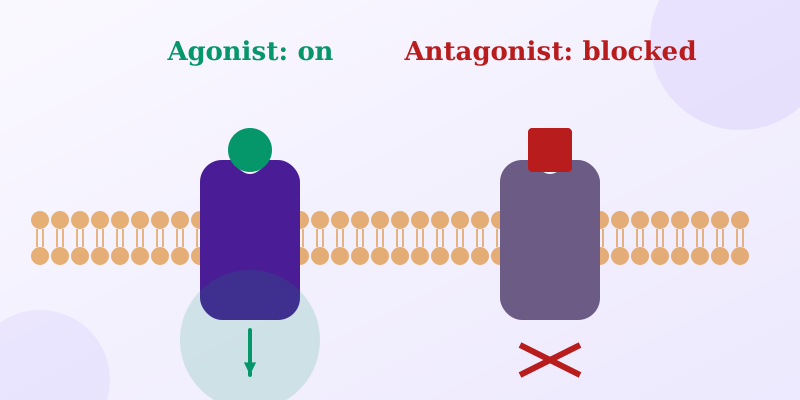
If an agonist is a key that fits a receptor and turns it, an antagonist is a key that fits but does not turn. By sitting in the lock it prevents the real key from working. That simple contrast is one of the most important ideas in pharmacology, because a large share of everyday medicines are antagonists rather than agonists. This article compares the two and explains the main types of antagonism.
What an antagonist does
An antagonist has affinity for a receptor (it binds) but little or no efficacy (it does not activate). On its own, a pure antagonist often produces no obvious effect. Its action becomes visible when an agonist is present: the antagonist reduces or prevents the agonist's response. In the body there is usually some natural agonist around, so blocking a receptor changes how a tissue behaves.
Beta-blockers are a familiar example. They occupy beta-adrenergic receptors in the heart and elsewhere, which limits the effect of adrenaline and noradrenaline on heart rate and the force of contraction. Antihistamines used for allergies reduce the effect of histamine at H1 receptors. Naloxone occupies opioid receptors and can displace opioid agonists, which is why it is used in emergencies to reverse opioid overdose.
Competitive (surmountable) antagonism
A competitive antagonist binds reversibly to the same site as the agonist. Agonist and antagonist compete for that site, and whichever is present at the higher effective concentration wins more of the receptors. In laboratory experiments, adding a competitive antagonist shifts the agonist's dose-response curve to the right: more agonist is needed to get the same effect, but with enough agonist the full maximal response can still be reached. That is why this type of antagonism is called surmountable.
The competition also works in reverse. Naloxone's effect can wear off before a long-acting opioid has cleared the body, so the opioid effect can return. This is one reason emergency guidance says that anyone given naloxone should still receive medical care.
Non-competitive and irreversible antagonism
Some antagonists do not simply compete at the agonist's binding site. An irreversible antagonist forms a very stable or chemical bond with the receptor, effectively removing that receptor from use until the cell makes new ones. A non-competitive antagonist may bind elsewhere on the receptor (an allosteric site) or block a later step in the signalling chain. In both cases, adding more agonist cannot fully restore the response, so the maximum of the dose-response curve falls. This is called insurmountable antagonism.
Other kinds of opposition
Pharmacologists distinguish receptor antagonism from other ways of reducing a response:
- Physiological (functional) antagonism: two agonists act on different receptors with opposite effects. For example, one substance may constrict a blood vessel through one receptor while another relaxes it through a different receptor.
- Chemical antagonism: one substance binds directly to another and inactivates it, without involving the receptor at all.
- Pharmacokinetic antagonism: one drug lowers the concentration of another, for example by speeding up its breakdown.
Where partial agonists and inverse agonists fit
The agonist-antagonist divide is really a spectrum. A partial agonist activates the receptor only part-way. When little natural agonist is present it acts as a weak agonist, but in the presence of a full agonist it can lower the overall response by taking up receptors that a full agonist would have activated more strongly. An inverse agonist goes further than a neutral antagonist and reduces a receptor's spontaneous background activity. Several drugs historically called antagonists, including many H1 antihistamines, are now understood to behave as inverse agonists in laboratory systems.
Why the distinction matters
Knowing whether a medicine is an agonist or an antagonist helps explain its effects, its side effects and why certain combinations are avoided. Two drugs that act in opposite directions on the same receptor can cancel each other out. Stopping an antagonist suddenly after long use can also matter, because tissues may have adapted, for example by making more receptors. That is why changes to regular medicines should be planned with the prescriber rather than made alone.
Key points
- Agonists bind and activate receptors; antagonists bind without activating and block agonist effects.
- Competitive antagonism can be overcome by more agonist; irreversible and non-competitive antagonism lowers the maximum response.
- Partial agonists and inverse agonists sit between and beyond these two categories.
Educational content only. It does not replace advice from a doctor, pharmacist or emergency service. In a suspected overdose, call your local emergency number.