What Is a Receptor Agonist? A Plain-Language Introduction
Educational information only, not medical advice; consult a qualified professional.
Almost every medicine you have heard of works by interacting with a specific molecule in the body. Very often that molecule is a receptor: a protein that recognises a particular chemical signal and responds by changing what a cell does. A drug or natural messenger that binds to a receptor and switches it on is called an agonist. This article explains the idea from the ground up, without assuming a background in chemistry.
Receptors as molecular switches
Cells are constantly receiving instructions. Nerve cells release neurotransmitters, glands release hormones, and the immune system releases signalling proteins. None of these messages would have any effect unless the receiving cell had a way to detect them. Receptors are that detection system. Each type of receptor has a binding site shaped to fit a particular messenger, and when the right molecule binds, the receptor changes shape. That shape change is passed on inside the cell, where it can open an ion channel, start a chain of enzyme reactions or alter which genes are switched on.
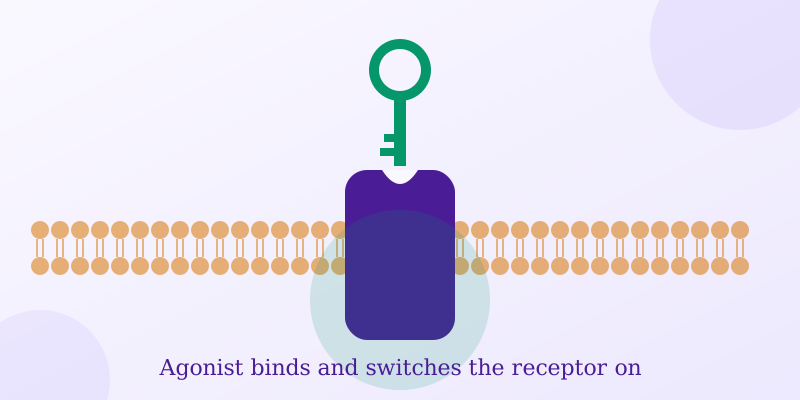
A useful (if imperfect) picture is a lock and key. The receptor is the lock, and the agonist is a key that not only fits but also turns. Some molecules fit the lock without turning it; those are antagonists, which are covered in a separate article on this site.
Natural agonists and drug agonists
The body's own messengers are called endogenous agonists. Adrenaline (epinephrine) and noradrenaline (norepinephrine) activate adrenergic receptors; acetylcholine activates muscarinic and nicotinic receptors; endorphins and enkephalins activate opioid receptors; dopamine and serotonin each have their own receptor families. Every one of these systems has several receptor subtypes, which is part of the reason the same messenger can have different effects in different tissues.
Many medicines are exogenous agonists: molecules designed or discovered to mimic a natural messenger at a chosen receptor. Inhaled bronchodilators that relax airway muscle, migraine medicines that act on certain serotonin receptors and modern diabetes medicines that act on the GLP-1 receptor are all examples. A drug agonist is not simply a copy of the natural messenger. It is usually changed so that it lasts longer, reaches the right tissue or favours one receptor subtype over another.
Two properties: affinity and efficacy
Pharmacologists describe an agonist with two separate ideas.
- Affinity is how strongly the molecule binds to the receptor. A high-affinity drug occupies receptors at low concentrations.
- Efficacy (sometimes called intrinsic activity) is how well the molecule activates the receptor once it is bound. A molecule can bind tightly and still produce only a weak signal.
Keeping these apart explains a lot. A full agonist can produce the maximum response the system allows. A partial agonist produces a smaller maximum response, even when every receptor is occupied. An antagonist has affinity but essentially no efficacy. An inverse agonist reduces a receptor's background activity below its resting level. Each of these is explored in more detail in other articles in this series.
Where receptors are found
Most drug receptors sit in the cell membrane, with a binding site facing outward. The largest group is the G protein-coupled receptor family, which works through internal signalling proteins. Another group, the ligand-gated ion channels, open a pore through the membrane within milliseconds of an agonist binding. A third group, the nuclear receptors, sit inside the cell and respond to fat-soluble hormones such as steroids and thyroid hormone by changing gene expression. The type of receptor largely determines how quickly an agonist acts and how long its effects last.
Why the concept matters
Thinking in terms of receptors and agonists helps make sense of things that otherwise look puzzling. It explains why two medicines aimed at the same condition can feel very different, why side effects often reflect the same receptor being present in another organ, and why the body can become less responsive to a drug that is used repeatedly (a process called desensitisation or tolerance). It also explains why drug interactions happen: two substances acting on the same receptor, or on opposing receptors, can add to or cancel out each other's effects.
It is also a reminder that the same receptor system is shared by medicines, natural messengers and, in some cases, substances of misuse. Understanding the mechanism is useful background, but it does not tell anyone whether a particular medicine is right for them.
Key points
- A receptor is a protein that detects a specific chemical signal and changes cell behaviour in response.
- An agonist binds to a receptor and activates it; the body makes its own agonists, and many medicines are designed agonists.
- Affinity (how well a molecule binds) and efficacy (how well it activates) are different properties.
- Receptor type and location shape how fast, how strongly and where an agonist acts.
This article is general education about how drugs work. It is not advice about any medicine or condition. Questions about your own treatment should go to a doctor or pharmacist.