Educational information only, not medical advice; consult a qualified professional.
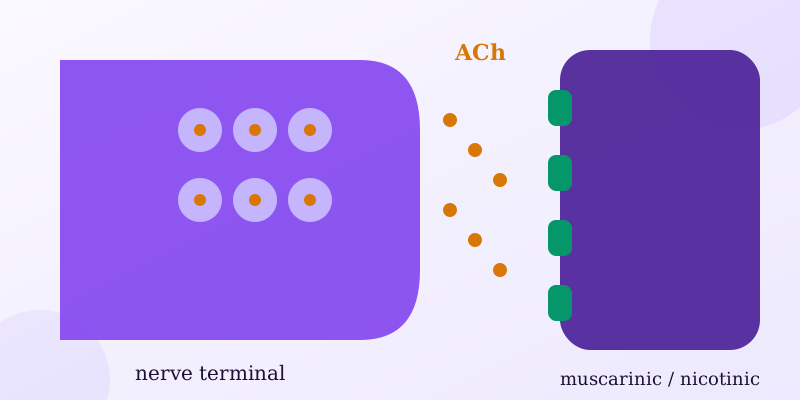
Acetylcholine was the first neurotransmitter to be identified, and it is still one of the most important. It controls skeletal muscle, much of the "rest and digest" (parasympathetic) nervous system and many brain circuits. Drugs that imitate it are called cholinergic agonists. Their effects depend on which of the two acetylcholine receptor families they activate.
Two receptor families
- Nicotinic receptors are ligand-gated ion channels. They are found at the junction between nerves and skeletal muscle, in autonomic ganglia and in the brain.
- Muscarinic receptors are G protein-coupled receptors with five subtypes, M1 to M5. M1, M3 and M5 mainly couple to Gq; M2 and M4 mainly couple to Gi. M2 receptors slow the heart, M3 receptors contract smooth muscle in the bladder, gut and airways and stimulate glands, and M1 and M4 receptors have important roles in the brain.
The families take their names from two natural substances used in early experiments: nicotine and muscarine (from certain mushrooms).
Why acetylcholine itself is not used as a medicine
Acetylcholine is broken down almost immediately by the enzyme acetylcholinesterase, and it acts at every cholinergic receptor at once. Direct-acting cholinergic medicines are therefore modified molecules that resist breakdown and, ideally, favour muscarinic over nicotinic receptors.
Direct-acting muscarinic agonists
- Pilocarpine is a plant-derived muscarinic agonist. As an eye drop it constricts the pupil and increases fluid drainage, and it has long been used in some forms of glaucoma; it is also used in some eye drops for age-related near-vision changes. Taken by mouth, it can increase saliva production in people with severe dry mouth, for example after radiotherapy or in Sjögren's syndrome.
- Cevimeline is another muscarinic agonist used for dry mouth in Sjögren's syndrome in some countries.
- Bethanechol stimulates M3 receptors in the bladder and has been used for certain types of urinary retention.
- Methacholine is used as a diagnostic agent: inhaled in controlled conditions, it helps assess airway responsiveness in suspected asthma.
More recently, a medicine combining xanomeline, a muscarinic agonist that favours M1 and M4 receptors in the brain, with trospium, a muscarinic antagonist that stays mainly outside the brain, was approved in the United States for schizophrenia. The design aims to activate brain receptors while blocking unwanted muscarinic effects elsewhere in the body.
Nicotinic agonists
Agonists at nicotinic receptors are used less often as medicines, because these receptors are spread across muscles, ganglia and the brain. Nicotine replacement products deliver nicotine without tobacco smoke to ease withdrawal, and varenicline is a partial agonist at certain brain nicotinic receptors used to support quitting smoking. In anaesthesia, suxamethonium (succinylcholine) briefly activates nicotinic receptors at the nerve-muscle junction and then leaves them unresponsive, producing short-lasting muscle relaxation.
Indirect agents are different
Cholinesterase inhibitors such as donepezil, rivastigmine and neostigmine are often grouped with cholinergic drugs, but they are not agonists. They slow the breakdown of the body's own acetylcholine, so they increase cholinergic activity only where acetylcholine is being released. Donepezil and rivastigmine are used in some forms of dementia; neostigmine is used, among other things, to reverse certain muscle relaxants after surgery.
Effects of too much cholinergic activity
Excess muscarinic stimulation produces a recognisable pattern: increased saliva, tears, sweating and airway secretions, more frequent urination, diarrhoea, abdominal cramps, a slow heart rate and narrowed airways. These effects explain the cautions for cholinergic agonists in people with asthma, certain heart rhythm problems or bowel or bladder obstruction. Severe poisoning with certain pesticides and nerve agents, which block acetylcholinesterase, produces an extreme version of the same pattern and is a medical emergency.
Key points
- Acetylcholine acts on nicotinic (ion channel) and muscarinic (G protein-coupled) receptors.
- Direct muscarinic agonists such as pilocarpine, cevimeline and bethanechol have specific uses in the eye, mouth and bladder.
- Cholinesterase inhibitors increase natural acetylcholine rather than acting as agonists.
- Typical cholinergic side effects follow from muscarinic receptors in glands, gut, bladder, heart and airways.
For education only. Questions about any medicine should be discussed with a doctor or pharmacist.