Educational information only, not medical advice; consult a qualified professional.
Most receptors discussed on this site sit in the cell membrane. Nuclear receptors are different: they wait inside the cell and, when activated, directly change which genes are switched on. Their agonists include some of the most widely used medicines, such as corticosteroids and thyroid hormone replacement. This article explains how this receptor family works and why its effects tend to be slow but long-lasting.
Ligand-activated transcription factors
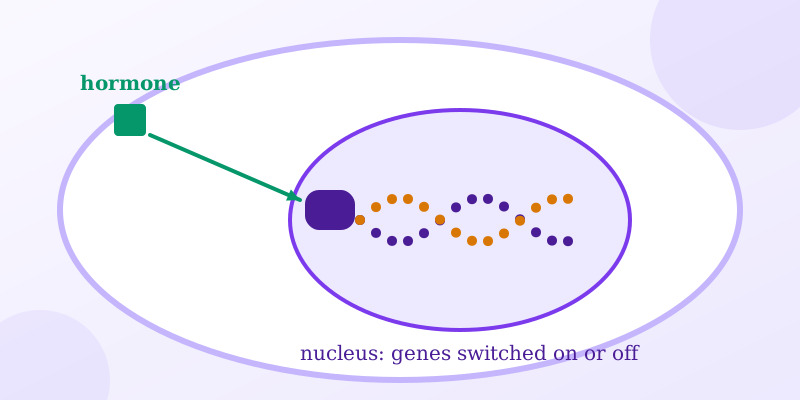
Nuclear receptors are proteins that bind to specific DNA sequences and control the transcription of nearby genes. Their natural agonists are mostly small, fat-soluble molecules, such as steroid hormones, thyroid hormone, vitamin D and certain fatty acids, that can cross the cell membrane. When an agonist binds to the receptor's ligand-binding domain, the receptor changes shape, sheds or recruits partner proteins (co-repressors and co-activators) and alters gene expression. The cell then makes more or less of particular proteins.
Some nuclear receptors, such as the glucocorticoid receptor, sit in the cytoplasm until an agonist binds and then move into the nucleus. Others, such as the thyroid hormone receptor, are already on DNA and switch from repressing to activating genes when the hormone arrives. Many work as pairs, either with an identical partner or with the retinoid X receptor (RXR).
Why effects are slow
Because nuclear receptor agonists work by changing protein production, their main effects generally take hours to days to appear and can persist after drug levels have fallen. That contrasts with ion channels, which respond in milliseconds, and G protein-coupled receptors, which typically respond in seconds to minutes. Some steroid effects are faster and are thought to involve separate, non-genomic mechanisms.
Examples of agonists
- Glucocorticoid receptor: corticosteroids such as prednisolone, dexamethasone and inhaled or topical steroids are agonists. They reduce inflammation and immune activity by changing the expression of many genes. Long-term use at higher levels can affect blood glucose, bone, mood, the eyes and the body's own steroid production, so courses are planned and often tapered by the prescriber rather than stopped abruptly.
- Mineralocorticoid receptor: fludrocortisone is an agonist used to replace aldosterone-like activity; spironolactone and eplerenone are antagonists at the same receptor.
- Thyroid hormone receptor: levothyroxine (T4) is converted in the body to the more active T3, which acts on thyroid hormone receptors to regulate metabolism. Thyroid replacement is guided by blood tests.
- PPARs: peroxisome proliferator-activated receptors regulate fat and glucose metabolism. Fibrates act on PPAR-alpha and are used for some blood lipid disorders; thiazolidinediones such as pioglitazone act on PPAR-gamma to improve insulin sensitivity in type 2 diabetes, with known effects including fluid retention.
- Vitamin D receptor: calcitriol and related analogues activate this receptor, influencing calcium handling and skin cell growth.
Antagonists in the same family
As with membrane receptors, nuclear receptors can also be blocked. Antagonists at the androgen receptor are used in some prostate cancers, and antagonists at the mineralocorticoid receptor are used in heart failure and some forms of high blood pressure. Mifepristone blocks progesterone receptors and, at different doses, glucocorticoid receptors. These examples show that the same pharmacological vocabulary of agonist, partial agonist and antagonist applies inside the nucleus as well as at the cell surface.
Agonist or antagonist depends on the tissue
Nuclear receptors show a striking form of tissue selectivity. Selective estrogen receptor modulators (SERMs), such as tamoxifen and raloxifene, act as antagonists at estrogen receptors in some tissues and as agonists in others. This happens because the receptor's shape with a given drug attracts different partner proteins, and the mix of partners differs between tissues. It is a clear example of why the labels "agonist" and "antagonist" sometimes depend on context.
Key points
- Nuclear receptors are intracellular, ligand-activated transcription factors.
- Their agonists are mostly fat-soluble hormones and similar molecules.
- Effects usually develop over hours to days and can outlast drug levels.
- Corticosteroids, thyroid hormone, PPAR agonists and vitamin D analogues are familiar examples; SERMs show tissue-dependent agonism.
Educational information only. Do not stop or change steroid, thyroid or other hormone treatment without speaking to your clinician.