Educational information only, not medical advice; consult a qualified professional.
Adrenaline (epinephrine) and noradrenaline (norepinephrine) prepare the body for activity: they raise heart rate, redirect blood flow and open the airways. They act through adrenergic receptors, and medicines that activate these receptors, called adrenergic agonists or sympathomimetics, are used in situations ranging from a blocked nose to emergency care. Because the receptor subtypes do very different jobs, the subtype a drug favours largely defines what it does.
The receptor subtypes
Adrenergic receptors are G protein-coupled receptors in two main groups, alpha and beta, a split first proposed by Raymond Ahlquist in 1948.
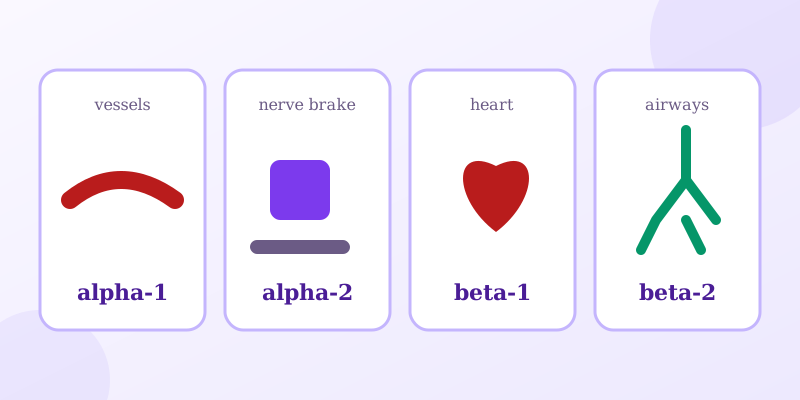
- Alpha-1 receptors couple to Gq, raising calcium inside cells. Their best-known effect is contraction of smooth muscle in blood vessels, which narrows them.
- Alpha-2 receptors couple to Gi. Many sit on nerve endings, where they reduce further release of noradrenaline, acting as a brake on the system. In the brain, they reduce sympathetic nerve output.
- Beta-1 receptors, mainly in the heart, increase heart rate and the force of contraction. They also trigger renin release from the kidney.
- Beta-2 receptors relax smooth muscle in the airways, some blood vessels and the uterus, and influence metabolism in liver and muscle.
- Beta-3 receptors are found in fat tissue and the bladder wall, where they relax the detrusor muscle.
All beta receptors mainly couple to Gs, which raises cyclic AMP.
Alpha-1 agonists
Phenylephrine is a typical alpha-1 agonist. Applied to the nose as a spray, it narrows swollen blood vessels in the lining and can relieve congestion; repeated use of nasal decongestant sprays for more than a few days can cause rebound congestion. Alpha-1 agonists are also used in hospital settings to support blood pressure and in eye drops to widen the pupil for examinations. Their main risks follow from vessel narrowing, such as raised blood pressure.
Alpha-2 agonists
Because alpha-2 receptors reduce sympathetic activity, agonists at these receptors tend to have calming and blood-pressure-lowering effects. Clonidine acts in the brainstem to reduce sympathetic output and has been used for high blood pressure; extended-release clonidine and guanfacine are also used in attention deficit hyperactivity disorder. Dexmedetomidine is used for sedation in intensive care and procedures. In the eye, brimonidine lowers pressure inside the eye in glaucoma. Sleepiness, dry mouth and low blood pressure are common effects, and stopping some of these medicines suddenly can cause a rebound rise in blood pressure, so changes are managed by the prescriber.
Beta-1 and beta-2 agonists
Beta-1 agonists such as dobutamine are used in hospital to support a weak heart. Beta-2 agonists, including short-acting relievers and long-acting maintenance inhalers, relax the airways in asthma and chronic obstructive pulmonary disease; they are covered in detail in this site's article on beta-2 agonists. Selectivity is relative, so beta-2 agonists can still speed the heart and cause tremor, especially at higher concentrations.
Beta-3 agonists
Mirabegron and vibegron are beta-3 agonists used for overactive bladder. By relaxing the bladder wall during the storage phase, they can reduce urgency and frequency. They offer an alternative to antimuscarinic medicines, which work by blocking a different receptor system. Blood pressure is usually monitored, particularly with mirabegron.
Mixed agonists
Adrenaline itself activates alpha and beta receptors. That broad profile is what makes it the first-line emergency treatment for anaphylaxis: alpha-1 effects support blood pressure and reduce swelling, while beta-2 effects open the airways. Adrenaline auto-injectors are prescribed with specific training, and their use is followed by emergency medical care.
Key points
- Alpha-1 receptors narrow blood vessels; alpha-2 receptors act as a brake on sympathetic activity.
- Beta-1 receptors drive the heart; beta-2 receptors relax airways; beta-3 receptors relax the bladder.
- Agonist uses range from nasal decongestion and glaucoma to sedation, heart support and overactive bladder.
- Selectivity is partial, so effects at other subtypes explain many side effects.
Educational content only, not medical advice. In an allergic emergency, call your local emergency number.